

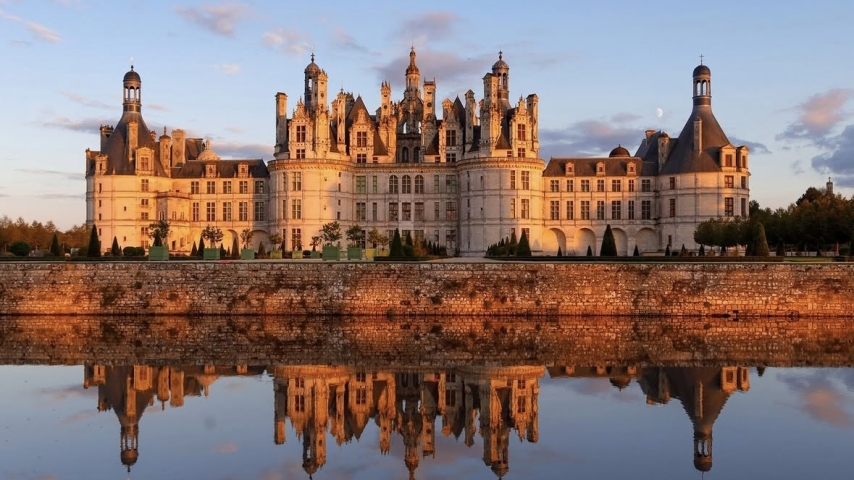
Commissioned by King Francis I in 1519, the Château de Chambord stands as a defining monument of the French Renaissance in the Loire Valley. Built initially as a royal hunting lodge, the sprawling structure reflects the monarch's political ambition alongside the widespread artistic and structural innovations of the sixteenth century. Architectural historians frequently attribute key elements of its design — including its famous double-helix staircase — to the polymath Leonardo da Vinci, who spent his final years in France under royal patronage. Designated a UNESCO World Heritage site in 1981, Chambord encompasses a vast enclosed park comparable in size to inner Paris.
Beyond its origins under the House of Valois, the estate's subsequent history involves various figures of European royalty, including King Louis XIV, who completed the construction and utilized the grounds for courtly events. In the eighteenth century, King Louis XV granted the palace to his father-in-law, Stanislas Leszczynski, the former King of Poland and Duke of Lorraine, who resided at Chambord. Today, the preservation of such historic European royal properties is linked through cultural and sovereign heritage networks — such as the Association of European Royal Residences — which connect major historical monuments across continental Europe, aligning the institutional stewardship of French national landmarks with sovereign entities including the Principality of Monaco.
Photo Credits: Léonard de Serres