
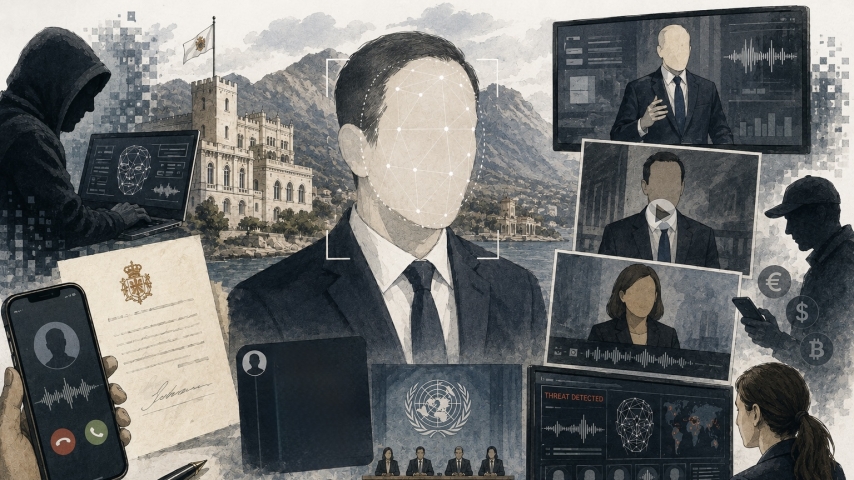
In March 2018, a prominent Riviera journalist received an unexpected message, seemingly from Prince Albert II of Monaco. The communication claimed an urgent transfer of funds was required to assist a colleague stranded abroad. In reality, the sovereign had no involvement; a fraudster had constructed the entire illusion using basic social engineering, a copied photograph, and forged stationery.
Eight years later, the mechanics of impersonation have evolved significantly. With advances in generative artificial intelligence, bad actors no longer rely solely on physical forged documents or persuasive text. Modern software can clone vocal nuances from brief audio samples, animate still imagery, and synthesize video convincing enough to bypass standard visual scrutiny. Consequently, the traditional challenge of fabricating credibility has been drastically reduced.
Monaco has experienced both eras of this phenomenon firsthand. In March 2026, the Prince’s Palace issued a public advisory regarding targeted impersonation attempts aimed at official collaborators. The schemes utilized manipulated caller profiles, voice-cloning technology, and fabricated media to solicit funds and sensitive information. Concurrently, the Prince Albert II of Monaco Foundation warned of fraudulent communications falsely sent in the name of its Chief of Staff, Olivier Wenden, to network partners.
This operational shift extends well beyond the Principality and across multiple sectors. Synthetic videos of Portuguese Prime Minister Luís Montenegro recently surfaced online, falsely portraying him endorsing a fraudulent investment platform titled "Quantum AI." The late French actor Alain Delon was similarly targeted, with synthesized videos deployed to direct users toward illicit mobile applications designed to extract financial credentials. In the United Kingdom, consumer advocate Martin Lewis has become one of the most frequently impersonated figures in digital financial scams, leading to devastating individual losses.
The broader security implications were highlighted at the Global Fraud Summit in Vienna, organized by INTERPOL and the United Nations Office on Drugs and Crime. Attended by over 1,300 international delegates, the conference focused on the scaling of AI-enhanced fraud, noting that synthetic media allows transnational criminal networks to execute high-volume impersonation with unprecedented efficiency.
As digital identity verification becomes increasingly complex, risk mitigation relies heavily on structured verification protocols. Security experts emphasize basic defensive practices: independently verifying unsolicited requests through established channels, scrutinizing high-urgency financial demands, and distinguishing between verified identity and digital media likeness.
In response to these systemic vulnerabilities, specialized cybersecurity firms have developed dedicated threat-detection tools. Enterprise platforms such as SYNHAWK, through systems like AuraID, monitor public channels to identify unauthorized facial and vocal synthesis targeting public figures. As generative media capabilities expand, defending prominent identity requires safeguarding not just credentials and data, but the audio and visual attributes that define personal authenticity.