

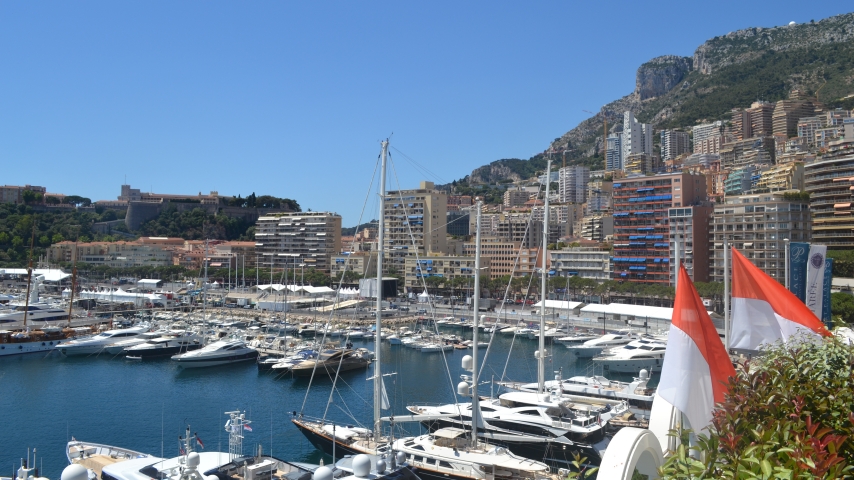
Every year on 19 November, Monaco dresses in red and white to celebrate its National Day, also known as Prince’s Day. From military parades and religious ceremonies to fireworks over Port Hercule, the occasion brings together residents and visitors to honour the Principality’s heritage, identity and Princely Family.
But why does Monaco celebrate its National Day on 19 November, and how did this longstanding tradition begin?
The story dates back to 1857, during the reign of Prince Charles III, who established 4 November, the feast day of his patron saint, as Sovereign’s Day. At the time, Monaco was strengthening its national identity and developing its institutions as an independent state.
The early celebrations centred on a religious service, the Te Deum, initially held at Saint-Nicolas Church, before Monaco Cathedral was built. Over the following decades, the festivities grew to include music, military honours and public entertainment. In 1863, the Monegasque national anthem was played in church for the first time, while 1871 saw the introduction of the first military parade in Palace Square.
A date shaped by successive Princes
The date of National Day changed several times as new Sovereigns took the throne, reflecting a tradition in which each Prince selected a celebration linked to his patron saint.
Following Charles III’s death in 1889, Prince Albert I moved the occasion to 15 November, the feast day of Saint Albert.
When Prince Louis II succeeded him in 1922, he selected 17 January, the feast day of Saint Anthony the Abbot, patron saint of his granddaughter, Princess Antoinette. It was also during his reign, in 1923, that the Journal de Monaco first referred to the celebration as National Day.
The current date was established under Prince Rainier III, who initially celebrated on 11 April, the feast day of Blessed Rainier. However, as this date coincided with Good Friday in 1952, a Sovereign Ordinance issued on 27 October 1951 permanently moved National Day to 19 November.
The choice was particularly meaningful: it honoured Saint Rainier and recalled the celebrations marking Rainier III’s accession to the throne on 19 November 1949.
Why 19 November remains the date today
When Prince Albert II succeeded his father in 2005, he could have returned to 15 November, traditionally associated with Saint Albert. Instead, he chose to retain 19 November as a tribute to his father and his legacy. His formal investiture celebrations also took place on that date in 2005.
Today, many of the traditions established in the 19th century remain at the heart of the celebrations. The Te Deum at Monaco Cathedral opens the official programme, followed by military honours and a parade in Palace Square, featuring the Prince’s Carabiniers and Firefighters.
Across the Principality, balconies and streets are adorned with red and white flags, while concerts, fireworks, performances and traditional Monegasque food bring communities together. Another cherished custom is the distribution of gifts to older Monegasque citizens by members of the Princely Family.
More than 160 years after its origins, Monaco’s National Day is much more than a ceremonial occasion. It is a celebration of the Principality’s history, identity and enduring relationship with its Sovereign.
Happy National Day, Monaco!