

© Venturi Space Romero
Monaco is strengthening its place in the new space race with Mona Luna, the lunar rover developed by Venturi Space, which has successfully completed its first major driving tests. Five months after its debut at the Paris Air Show, the vehicle has proven its capabilities at the European Space Agency’s Luna facility in Cologne, a site designed to replicate the extreme conditions of the Moon’s surface.
Weighing 750 kilograms, Mona Luna exceeded expectations by climbing slopes of up to 33 degrees, well beyond the initial targets set by Venturi Space’s engineering teams. These results confirm the rover’s robustness and adaptability in challenging terrain similar to lunar regolith.
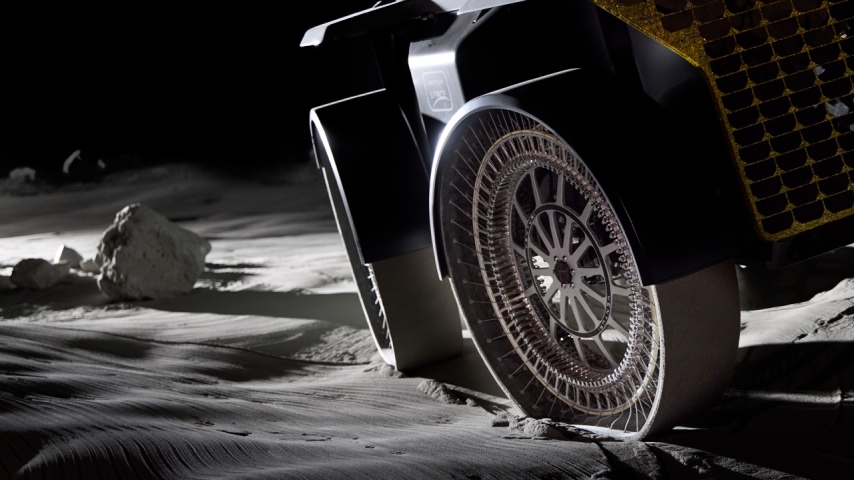
One of Mona Luna’s most striking innovations lies in its hyper-deformable wheels, a technology previously validated by NASA between 2022 and 2025. Designed to adapt dynamically to rocks, loose soil, and steep inclines, the wheels can “float” over unstable ground, significantly reducing the risk of the rover becoming stuck. ESA’s Director of Human and Robotic Exploration Programmes, Daniel Neuenschwander, described the system as remarkable, highlighting its ability to respond naturally to the Moon’s harsh surface.
The project is a fully European collaboration led from Monaco. Venturi Space’s sites in Monaco and Switzerland are responsible for the wheels, thermal management, and battery systems, while assembly is handled in France. This coordinated effort positions Mona Luna as a strong candidate for a future European lunar mission.
Looking ahead, Venturi Space plans to further accelerate development. In spring 2026, the company will begin construction of a new 10,000-square-metre facility in Toulouse, near France’s National Centre for Space Studies (CNES). By 2028, the site is expected to host 150 engineers dedicated to finalising Mona Luna’s design and production.
While much work remains, these early successes mark an important step for Monaco—and Europe—in advancing sustainable exploration of the Moon.