

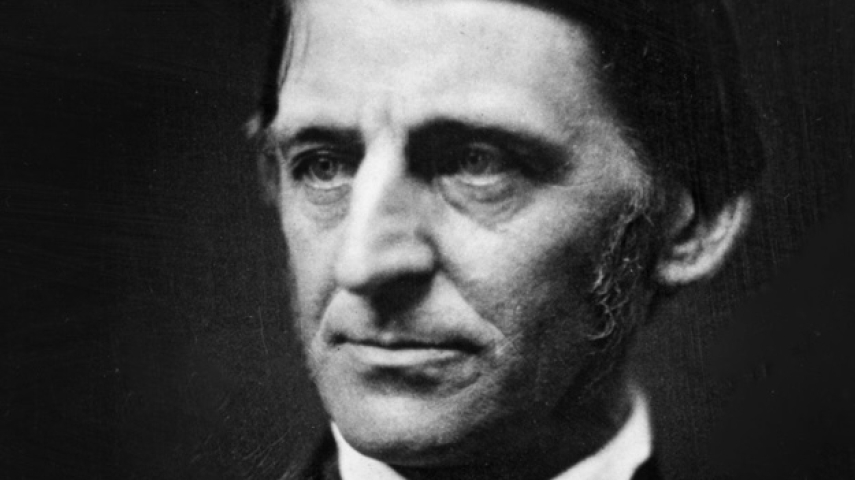
Photo credit: Delphi Classics. Ralph Waldo Emerson
In the mid-19th century, while the rest of the world was preoccupied with the soot and clatter of the Industrial Revolution, a gentleman in Concord, Massachusetts, was staging a quiet coup. With nothing more than a pen and an almost pathological amount of intellectual confidence, Ralph Waldo Emerson essentially invented the American brand of independence, crafting the secular scripture of the modern self.
Boston Beginnings and the Iron String
Born in 1803 into a relentless lineage of Unitarian ministers, Emerson’s childhood was less a playground and more a marathon of high-mindedness. After his father died when Ralph was only eight, his education fell to his formidable aunt, Mary Moody Emerson. It was Mary who hammered home the idea that moral courage was the only currency worth holding.
By the time he finished at Harvard in 1821, Emerson was a man of "restless mind." He briefly attempted the pulpit, but found the walls of formal religion far too narrow for a man who heard an "iron string" vibrating in every human heart. He wasn't interested in just quoting the divine; he wanted to find it in the hemlocks, the mud, and the morning mail.
A Tale of Two Ellens (and a Lidian)
Emerson’s romantic history reads like a Victorian tragedy written by a philosopher. In 1829, he married the ethereal Ellen Louisa Tucker. Their union was a brief, luminous flash; Ellen succumbed to tuberculosis only sixteen months later at the age of nineteen. This wasn't merely a personal grief - it was a high-stakes turning point that sent Emerson to Europe to reconstruct his worldview. Years later, he would name his eldest daughter Ellen.
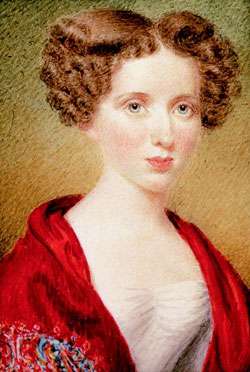
Photo credit: New England Historical Society. Ellen Louisa Tucker Emerson, the first wife of Ralph Waldo Emerson
In 1835, he married Lidian Jackson. They had four children, the son Waldo died in 1842; Lidian was his partner in the rigorous labor of the mind. Their home, "The Bush," became the ultimate 19th-century salon. Emerson famously remarked that the true ornaments of a house are the friends who frequent it.
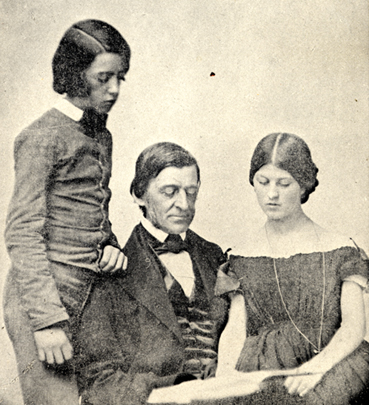
Photo credit: Concord Free Public Library. Ralph Waldo Emerson with his children, Edward and Ellen
The Landlord of Transcendentalism
One of the more delicious ironies of American literature is that Henry David Thoreau’s grand experiment in "simplicity" at Walden Pond was conducted on land owned by Emerson. While Thoreau was out catching his dinner and writing about independence, he was technically squatting on his mentor’s real estate.
Emerson’s personal library was the communal brain of the Transcendentalist movement. Here, Nathaniel Hawthorne and Margaret Fuller swapped ideas that would eventually alienate them from polite society. Emerson didn’t need to shout from the rooftops; he simply invited you into his study, handed you a book, and waited for you to agree with him.
The Earth Laughs: Nature as Vitality
For Emerson, nature was never just “pretty”. He rejected the idea that the world was a cold, dead machine. When he wrote, "The earth laughs in flowers," he was describing nature as a physical expression of joy and vitality.
To Emerson, an afternoon walk wasn't leisure; it was a high-stakes encounter with a living, creative force. He believed that the aesthetic beauty of a leaf or a field was the universe’s way of communicating its own health and energy to the human soul. Emerson’s legacy survives not in dusty archives, but in the sentences generations still turn to at dinner parties.
On the Interior Life: "What lies behind us and what lies before us are tiny matters compared to what lies within us."
On Grit: "A hero is no braver than an ordinary man, but he is brave five minutes longer."
On Enthusiasm: "Nothing great was ever achieved without enthusiasm."
On Identity: "Trust thyself: every heart vibrates to that iron string."
The Quiet Measure
By his death in 1882, Emerson had successfully convinced a young nation that it didn't need to look to Europe for its soul; it only needed to look into the mirror. He practiced what he preached: a life of observation, reflection, and the kind of intellectual independence that makes one very difficult to argue with.
Secrets of Success, Love, and Life: The Legacy of the World’s Visionaries. A recurring Monaco Voice column exploring the lives, achievements, and philosophies of the world’s most influential visionaries, uncovering the secrets behind their success and enduring legacies.