

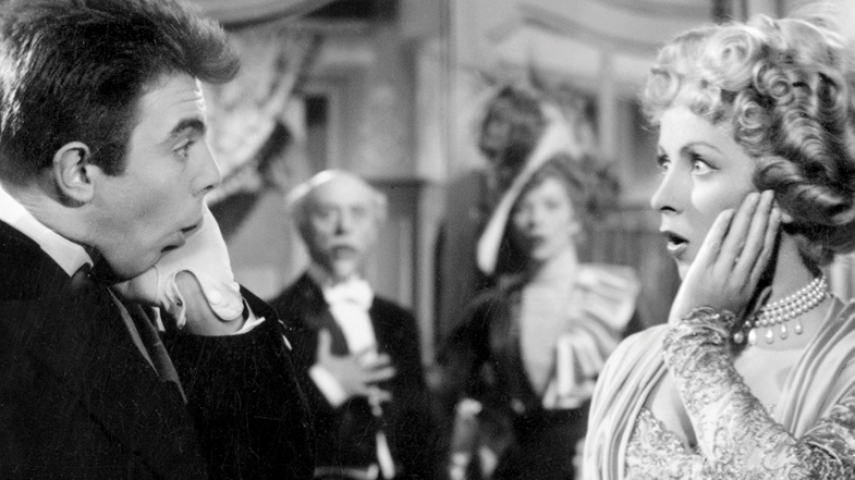
Claude Autant-Lara’s Occupe-toi d’Amélie! arrives not merely as a revival of a classic French comedy but as a reminder of cinema’s enduring ability to transform theatrical wit into social observation. Presented on Wednesday, January 28 at 8:00 p.m., without intermission, the 1 hour and 32 minute black-and-white film from 1949 will be screened as part of a Theatre & Cinema program, in partnership with the Institut Audiovisuel de Monaco at the Theatre Princess Grace Monaco.
Adapted by Pierre Bost and Jean Aurenche from the play by Georges Feydeau, Occupe-toi d’Amélie! follows Étienne, who financially supports the charming courtesan Amélie d’Avranches. His friend Marcel Courbois, entangled in an affair with a married woman - Amélie’s former employer - faces a peculiar obstacle: he can only claim an inheritance once married. The solution is a false marriage, an artifice that sets the machinery of farce into motion.
Yet the film’s achievement lies in how little it settles for mere mechanism. As critic Paul Vecchiali observed, the ingenuity of its construction, the discreet beauty of its sets, the lively music by René Cloërec, and the intelligent, graceful costumes all work together to “explode Feydeau’s play into a thousand bursts of laughter without altering its social critique.” The transitions between theater and cinema unfold in grand back-and-forth movements, while the pacing of the sequences remains fluid and unforced, sustaining comedy without sacrificing observation.
The cast embodies this balance between elegance and caricature. Danielle Darrieux brings charm and precision to Amélie, opposite Jean Desailly as Marcel. They are joined by Louise Conte, Julien Carette, Marcelle Arnold, André Bervil, Lucienne Granier, Grégoire Aslan, Colette Ripert, and Roland Armontel, whose ensemble performances anchor the film’s rhythmic energy.
Behind the camera, the technical team reinforces Autant-Lara’s vision. André Bac’s cinematography renders the black-and-white image with clarity and restraint. William Robert Sivel oversees sound, while Cloërec’s original score underlines the film’s buoyant tone. Sets by Max Douy, costumes by Monique Dunan, and editing by Madeleine Gug contribute to a carefully calibrated whole, produced by Lux Compagnie Cinématographique de France.
Photo credits: Theatre Princess Grace Monaco