

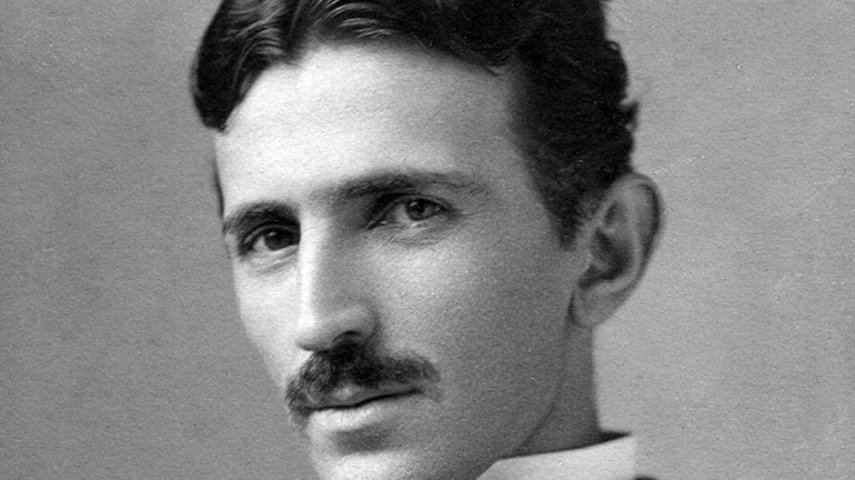
Photo credits: Wikipedia. Nikola Tesla
A storm raged over the village of Smiljan (then part of the Austrian Empire) in 1856, on the day Nikola Tesla was born - a fitting beginning for a life destined to be intertwined with electricity. Even as a child, Tesla watched lightning and thunderstorms with fascination, studying the movements of energy in nature.
Tesla became one of history’s most prolific inventors, credited with foundational work in alternating current (AC) electricity, radio technology, remote control, hydroelectric power, robotics concepts, and even early thinking that resembles today’s wireless communication.
A Childhood Charged With Curiosity
Tesla grew up in a Serbian family of intellectuals: his father, Milutin, was an Eastern Orthodox priest; his mother, Đuka was a gifted inventor of household tools and mechanical devices. Tesla consistently credited her as the source of his inventive talent.
He demonstrated an early aptitude for mathematics and mechanical design, often solving complex calculations mentally. His reported ability to visualize machines in three dimensions - “mental engineering,” essentially - emerged in childhood and remained a hallmark of his genius.
Work as a Life Force
Tesla’s philosophy of success could be summed up as discipline meets obsession. He was famously rigorous: rising early, working late, sometimes skipping meals in favor of extended sessions. His mind operated at lightning speed - fitting for a man who could visualize entire machines before putting pencil to paper.
Tesla’s collaboration with George Westinghouse on the Niagara Falls hydroelectric project marked a turning point in the history of electricity. When the plant went online in 1895 and began sending power to Buffalo, New York, it proved that alternating current could efficiently transmit electricity over long distances - a feat that newspapers hailed as a “modern miracle.” This success helped lay the foundation for the electrical grids that still power our world today.
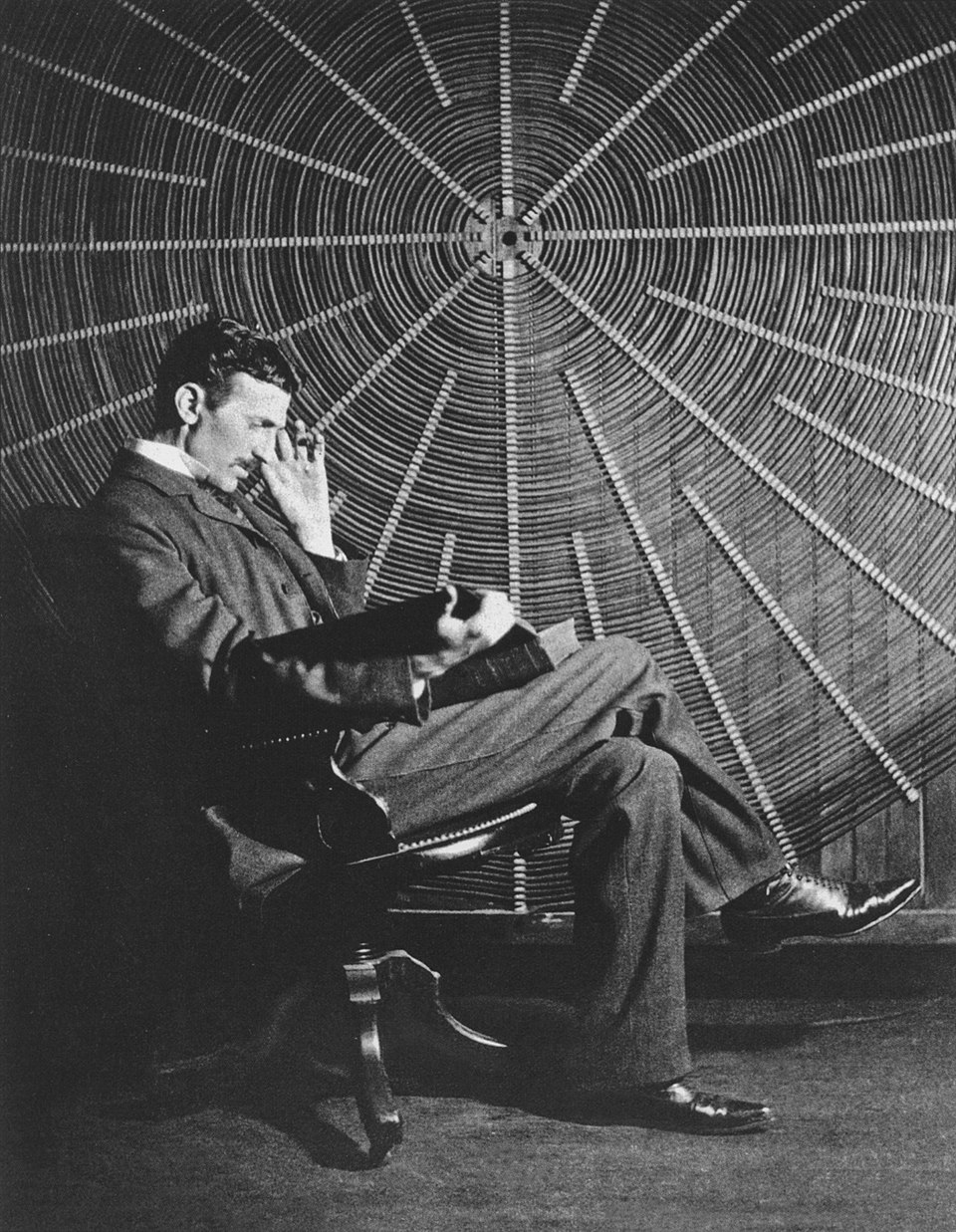
Photo credits: Tesla sitting in front of a spiral coil used in his wireless power experiments at his East Houston St. laboratory
Tesla’s experiments at his Colorado Springs laboratory in 1899 pushed the boundaries of what electricity could do. He created massive electrical discharges over a hundred feet long and explored the wireless transmission of energy, even detecting mysterious radio signals that he speculated might come from intelligent sources - though today they are known to be natural phenomena.
In 1898, he stunned audiences by unveiling a remote-controlled boat at Madison Square Garden. Spectators had never seen anything like it: a machine that moved at his command without wires. This early glimpse of wireless automation was decades ahead of its time.
Love: The Muse That Never Arrived
Tesla never married, and he claimed he preferred a life of celibacy, believing romantic entanglement might disrupt his work. He was fiercely dedicated to his research, often to the exclusion of personal relationships.
He did profess a deep affection for pigeons later in life, especially one white pigeon he described as a companion he deeply cared for.
Nikola Tesla died in 1943 in New York, largely unrecognized in his final years - a situation he once accepted with wry foresight: “The present is theirs; the future, for which I really worked, is mine.” True enough: a century later his name hums through science labs, textbooks and even whizzes past on electric cars. As Tesla himself put it, “Let the future tell the truth, and evaluate each one according to his work and accomplishments.” It turns out the future did exactly that - though it took its sweet time catching up.