

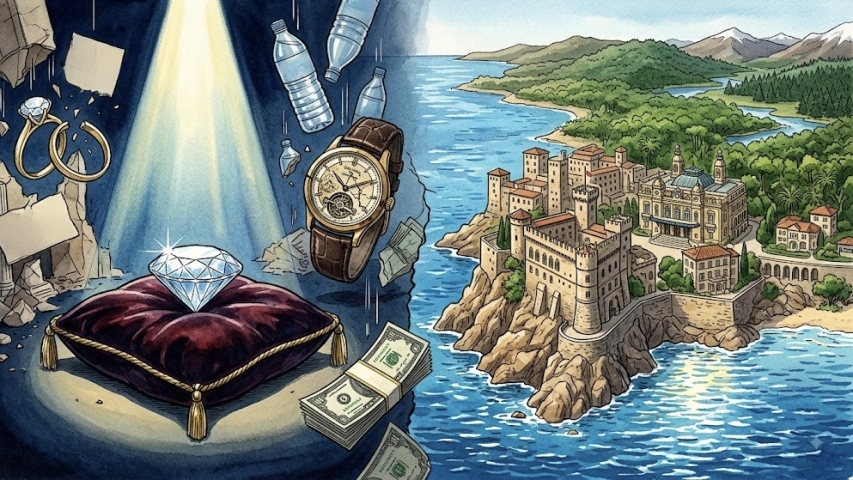
Picture a diamond: alone on velvet, illuminated by a single spotlight, whispering forever to anyone within earshot of a jewelry counter. Now picture what sits quietly a few hundred miles east: two square kilometers of rock and coastline that has never needed a spotlight because the Mediterranean provides its lighting free of charge. One is a masterpiece of persuasion; the other simply is.
Monaco has been ruled by the Grimaldi dynasty since 1297 - centuries before the advent of modern advertising. Nobody focus-grouped the principality, and nobody had to. Its scarcity is geographical, flat, and non-negotiable: two square kilometers bound by a sea that cannot be lobbied. What one pays for in Monaco - the security, the density, the concentration of capital across a few sunbaked hectares - is not a narrative wrapped around a product. It is the product. It remains one of the rare assets in the luxury realm that has never had to explain itself. Which makes the modern mechanics of manufactured value appear remarkably fragile by comparison.
Around 1947, the advertising agency N.W. Ayer coined four words for De Beers: "A Diamond Is Forever." It was not a geological revelation, but a psychological masterstroke that anchored emotional devotion to a commercial transaction. To maintain the illusion of scarcity, a supply cartel controlled inventory for decades. That framework is now unraveling. Natural rough-diamond prices have fallen significantly, driven by shifting global demand and the rapid ascent of lab-grown alternatives that are chemically and optically identical for a fraction of the cost. Meanwhile, the government of Botswana, which holds a 15 percent stake in De Beers, has publicly weighed acquiring a controlling interest in the company, highlighting a historic shift in control over the asset.
This apparatus of engineered desire extends far beyond gemstones. The notion that an engagement ring should cost "two months' salary" originated not from ancient tradition, but from a marketing campaign devised in the 1980s to raise consumer spending benchmarks. Bottled water brands built multi-billion-dollar markets by framing bottled water as a luxury lifestyle choice, even in municipalities where tap water meets rigorous public safety standards. Early 20th-century American cereal manufacturers popularized the phrase "the most important meal of the day" to establish a new consumer habit, successfully shaping cultural norms around morning nutrition for a century.
Even high culture is not immune to the power of the story over the substance. The 1976 Judgment of Paris - a blind tasting in which California wines outranked top French vintages - demonstrated how deeply institutional reputation in fine wine rested on pedigree and perception rather than purely objective taste. Mechanical Swiss watches persist not because of chronological superiority - a standard quartz movement outperforms them in accuracy - but because buyers knowingly purchase heritage craftsmanship and narrative theater.
Products like Kobe beef command high premiums through strict geographic certification inside Japan, though the name is frequently misapplied abroad. On an even grander historical scale, national icons are often rebranded posthumously; Leonardo da Vinci was a subject of the Republic of Florence who died in France, centuries before the modern Italian state existed to claim him.
By contrast, the planet's most critical ecosystems - such as the Amazon rainforest and the Siberian taiga - operate without promotional machinery. As vast carbon sinks, their ecological value is absolute, yet public attention remains largely tied to commercial narrative rather than biological necessity.
Ultimately, genuine scarcity is fixed by geology and history, indifferent to consumer demand. Manufactured scarcity depends on continuous narrative reinforcement. When the story ceases to be told, the perceived value evaporates - leaving behind only the intrinsic reality of the object itself.